Mulching for Small-scale Farms: Organic vs. Plastic Mulches and How to Choose
By Jonathan Dysinger and John Dysinger
Updated on
Show Transcript
0:00The last couple of weeks, we've been talking about dealing with weeds, how to manage weeds, how to handle cultivation.
0:06This week, we're going to be talking about mulches, the the pros and cons of using mulches. I'm here at Bountiful Blessings Farm with my dad, John, who's
0:14been a commercial market farmer for 27 years and uh has a lot of experience in this. So, what's your recommendations?
0:21is what are the pros and cons of using mulch? Whether that's some sort of organic material like leaf leaf mulch,
0:28which I know we've used, or or wood chips for certain crops, or plastic mulches like landscape fabric or, you know, single-use plastics.
0:37Yeah. Well, there's pros and cons to to each of them. You know, obviously from an organic point of view, it's always
0:45nice to be using organic mulches. Uh whether that's wood chips or straw or hay or uh leaf mulch, leaf mold,
0:57whatever they want to call it. Um so adding that organic matter is always a good thing. And of course, one thing
1:04that's popular now is just deep compost mulches. Um,
1:12the obvious upside to those is that you're you're building your soil as you
1:18hopefully eliminate weeds. Um, the downside to any kind of mulch is that you eliminate the ability to cultivate.
1:29We talked about cultivation and dealing with those small weeds, but when your ground is covered with something, you
1:37obviously can't use those tools um to to do it. So,
1:46what's left is hand weeding. Mhm. And so that can be a challenge. You know, I've
1:52never used wood chips or straw thick enough to eliminate all weeds. Yeah. You
2:01know, they it certainly helps um get rid of a lot of weeds, but you're still going to have weeds and then you're you're you're hand pulling. So,
2:13that is definitely a downside.
2:16Now, you know, the alternative to organic mulches would be non-organic mulches, um, which would be things like
2:25plastic. There's a lot of plastic culture that goes on where, um, they lay
2:32black plastic over raised beds, and it's actually very effective, not only for
2:39keeping weeds out, but for helping plants to grow really well. Um, and then of course there's quick plant fabric,
2:48which the beauty of quick plant fabric over just plastic mulches is that it's reusable for many years. So that is a
2:58nice thing. And um I'll just tell you in a spring like
3:05we've had this year, we've had so much rain. Um, I think last week we had three
3:12days without rain, which I think was the first time in I don't know 6 weeks or something where we had three consecutive days without rain.
3:22In weather like this, cultivation becomes almost impossible.
3:30And so if you were relying just on cultivation,
3:36you would have a big mess on your hands after 6 or 8 weeks of in uncovered growing space. Yeah. In uncovered
3:44growing. So, because we've largely gone to using quick plant fabric in our
3:51outside beds, um what could have been a disaster has not been because of
3:59most of the ground being covered with quick plant fabric. And you've mentioned a couple of times the need to not cultivate or not weed unless the soil is
4:08dry, like if the soil is still wet or moist, like when we've had just copious amounts of rain. Uh, but just so our viewers understand, the reason for that
4:16is because the weeds in order to die really kind of have to dry out. So if the soil is just wet and moist and it's
4:24raining, you come in and cultivate them and kind of uproot them. Even if they're laying on top of the soil, they can still root right back in uh quickly
4:32unless they dry out. So that's the reason for that. So yeah, I mean with the exception of potentially a deep compost, you're right. you know, most of
4:41these organic mulches you can't really cultivate. I mean, if it was a a loose compost, you could probably do some com some cultivation, but other than that,
4:49yeah, you're you're pretty much uh you know, at the mercy of the weeds and having to get down on your hands and knees and pull them. Um let's talk about the plastic mulches a little bit. So,
5:00for those that that maybe don't haven't heard a lot of the backstory to Bountiful Blessings Farm, um the farm started 27 years ago as primarily and
5:10really exclusively aupic strawberry operation. So, the first year we planted what an acre or more of strawberries.
5:19Yeah. 17,000 plants um directly on the dirt. It was it was in hindsight it's like what in the world were we thinking?
5:28But anyways, it just directly into raised beds and uh and we thought, "Oh,
5:34this is great. We're going organic. It's going to be an organic pick operation."
5:38And it was just a total disaster. I mean, the weeds took over. But not even that, you know, when when we did finally control weeds, sort of control weeds on
5:46a small section of the field. Then when it comes to harvesting or or you know the fruit is starting to ripen, it's just rotting almost instantly because
5:55it's just in contact with the soil and it's just your berries are just terrible. So in in some situations like that, it's just almost no way to avoid using some sort of plastic mulch. Well,
6:07we were young and idealistic and um yeah, we were going to do uh strawberry
6:15plastic culture without the plastic. And I mean, we were planning to put down straw to cover the ground, but yeah, the
6:25weeds took over before we had the opportunity to put the straw down. It was just a a very simple beginner's
6:34mistake. We we didn't know what we were doing.
6:37Um, and we thought the the fall frost was going to kill the weeds, but it didn't. Anyway, yeah, we we have lots of
6:45stories about weeds. It's just an example, I guess, of of certain crops that just it's almost
6:53Yeah, you can be all idealistic about it and and you can hey, give it a try if you really want to, but there's certain things that it's just going to save you
7:02and and really ultimately is the difference between running a profitable operation and not running a profitable operation. I mean, if you were growing,
7:10you know, head lettuce on just bare soil, you know, it's just uh uh it's a mess. I mean, we we would have lost the
7:19farm if we had tried to continue doing strawberries on bare ground. That's the bottom line. The only way we became profitable was to start using plastic.
7:30And we definitely try to limit it. Um but it makes a huge difference. Yeah.
7:37So, and you know, with straw, you end up with a whole crop of wheat if you put down wheat straw. So it Yeah. Well, and
7:47tucking the straw in around the plants just takes a copious amount of work. And so, um, that's a good word. Copious.
7:54Well, you know, I was homeschooled.
8:00You know, I think that, uh, we've talked about a lot of cool stuff here. You know, mulch is a is a powerful tool.
8:08There's pros and cons to all of this.
8:10Um, I think my encouragement would just be think long and hard about how idealistic you want to be about not
8:16utilizing uh plastics. You know, I'm fully supportive of not utilizing single-use plastics as much as possible.
8:24Like just using it once and throwing it away is uh less than ideal for sure.
8:30But, you know, if you go ahead and invest in some highquality woven fabrics that are UVT treated that that are rated for 10 years of life, you know, uh I
8:39feel like that's a good investment and our our sales numbers on that stuff indicates that a lot of people have come to the same conclusion. So, yeah, it's
8:48just uh one of those things you have to weigh the pros and cons and figure out what's going to work for you. Um, I hope this information has been helpful. You have any closing comments?
8:59Weeds are huge. That's there's no getting around it. And and getting coming up with systems for keeping it
9:08under control is is huge. And um cultivation is a lot of work. I enjoy
9:15it. I love it. In fact, I love hand weeding. But you're not making money when you're cultivating and weeding. And
9:24so that's the bottom line. And if you're trying to do this as your income, you got to be making money for sure. All righty. Well, again,
9:34I hope this information has been helpful. And if you have questions, feel free to go to the Farmersfriend website,
9:40farmersfriend.com, and reach out to our customer support team. Until until next time, happy growing.
9:47[Music]
Organic mulches like straw, wood chips, and compost build soil but won't fully eliminate weeds — and they prevent you from cultivating, leaving you with hand-pulling as the only option. For most market farmers, UV-stabilized landscape fabric like Quick-Plant Fabric is the most practical choice: it suppresses weeds for the entire season, lasts up to 10 years, and can be the difference between a profitable operation and one that drowns in weed pressure.
If you've been following our series on weed management, you know that cultivation is a powerful tool — but it has limits. You need dry soil. You need to catch weeds early. And you need to be able to get into the field consistently.
What happens when it rains for six weeks straight and you can't cultivate at all?
That's exactly the situation my dad, John Dysinger, faced this spring at Bountiful Blessings Farm. After more than six weeks of nearly continuous rain, they had maybe three consecutive dry days — the first stretch without rain in over a month. In a season like that, relying solely on cultivation in uncovered growing space would have been a disaster.
It wasn't, though. And the reason was mulch — specifically, the landscape fabric covering most of their outdoor beds.
In a recent video, my dad and I talked through the full range of mulching options, the honest pros and cons of each, and why he's landed where he has after 27 years of trial and error.
What Are the Different Types of Mulch for Market Farms?
Mulches fall into two broad categories: organic (biodegradable) and plastic (synthetic). Each has legitimate uses, and each comes with trade-offs.
Organic mulches include wood chips, straw, hay, leaf mold, and deep compost. These add organic matter to your soil as they break down, which is always a positive for soil health.
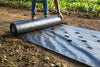
Plastic mulches include single-use black plastic, woven landscape fabric, and pre-burned planting fabrics like Quick-Plant Fabric. These don't build soil, but they suppress weeds far more effectively and can be reused for many seasons if they're UV-stabilized.
What Are the Pros and Cons of Organic Mulches?
The upside of organic mulches is clear: you're building your soil while suppressing weeds. Wood chips, straw, leaf mold, compost — they all add organic matter and feed soil biology as they decompose. From a regenerative standpoint, that's ideal.
But here's the honest reality from 27 years of using them: my dad has never used wood chips or straw thick enough to eliminate all weeds. They help — significantly — but weeds still come through. And once your beds are covered with organic mulch, you can't cultivate. Your hoe, your wheel hoe, your collinear hoe — none of them work through a layer of mulch.
What's left? Hand weeding. On your hands and knees, pulling weeds one at a time.
Straw comes with its own bonus problem: if you use wheat straw, you're likely to end up with an entire crop of volunteer wheat growing in your beds. And tucking straw around individual plants takes an enormous amount of labor.
Deep compost mulch is an interesting newer approach. If the compost is loose enough, you can potentially still do some light cultivation through it. But even with compost, complete weed elimination is rare.
What Are the Pros and Cons of Plastic Mulches?
Plastic mulches are extremely effective at weed suppression. Black plastic laid over raised beds eliminates weeds and also helps plants grow well by warming the soil and retaining moisture.
The obvious downside is the environmental concern — and it's a legitimate one. Single-use plastic that gets thrown away after one season is hard to justify from a sustainability standpoint.
But there's an important distinction between single-use plastic and reusable, UV-stabilized woven fabrics. Products like Quick-Plant Fabric can last up to 10 years in direct sunlight. That's not disposable plastic — that's a long-term tool. My dad has had landscape fabric on the farm that's lasted a decade or more.
The pre-burned holes in Quick-Plant Fabric add another layer of efficiency — you just roll it out and plant, no jig-building or torch work required. If the pre-burned version is more than your budget allows, you can buy plain UV-stabilized landscape fabric and burn the holes yourself. Either way, you're investing in a multi-year tool, not a throwaway product.
Why Mulch Can Be the Difference Between Profit and Failure
My dad doesn't say this lightly, but it's something he believes deeply from experience: for certain crops, plastic mulch is the difference between a profitable operation and losing the farm.
Bountiful Blessings Farm started 27 years ago as an organic pick-your-own strawberry operation. The first year, they planted over 17,000 strawberry plants directly into bare raised beds — no plastic, no mulch, just soil. They were young, idealistic, and convinced they were going to do organic strawberries without plastic.
It was a total disaster.
The weeds took over before they could even get straw down. They'd planned to use straw as mulch, but the weeds outpaced them. They assumed the fall frost would kill the weeds. It didn't. And even in the small sections where they managed to get weed pressure somewhat under control, the strawberries themselves were rotting on contact with the bare soil — the fruit quality was terrible.
As my dad puts it, they would have lost the farm if they'd tried to continue growing strawberries on bare ground. The only way they became profitable was switching to plastic mulch culture.
That's not to say you should cover everything in plastic. But it's worth hearing from a farmer who's been doing this for nearly three decades that idealism about avoiding plastics has to be balanced against the reality of running a viable business.
When Does Mulch Matter Most?
This spring drove the lesson home harder than ever. With six-plus weeks of nearly continuous rain, any uncovered growing space that depended on cultivation for weed control would have been overrun. You can't cultivate wet soil — the weeds just re-root in the moisture instead of drying out and dying.
Because Bountiful Blessings Farm had largely switched to Quick-Plant Fabric on their outdoor beds, what could have been a catastrophic season for weed pressure turned out fine. The fabric did its job while the rain kept falling and the cultivators sat idle.
That kind of resilience — a system that works even when the weather doesn't cooperate — is what makes landscape fabric worth the investment for market farmers who depend on outdoor production.
The Takeaway
Mulching is a tool with real trade-offs, and the right choice depends on your farm, your crops, and your priorities.
Organic mulches build soil and are always worth using where you can. But be realistic: they won't eliminate weeds entirely, and they take away your ability to cultivate.
For crops where weed pressure is make-or-break — strawberries, head lettuce, any long-season crop in uncovered ground — UV-stabilized landscape fabric is the most practical solution. Invest in quality material that lasts multiple years, and think of it as a long-term tool rather than single-use waste.
As my dad says, he loves hand weeding. But you're not making money when you're weeding. And if you're trying to make this your income, you've got to be making money.
Frequently Asked Questions
It depends on your goals. Organic mulches like straw, wood chips, and compost build soil but won't fully stop weeds and prevent mechanical cultivation. For most commercial market farmers, UV-stabilized woven landscape fabric offers the best balance of effective weed suppression and long-term value — lasting up to 10 years in direct sunlight.
Not completely. Straw, wood chips, and leaf mold reduce weed pressure significantly, but weeds still push through even thick layers. Once mulch is down, you also can't use cultivation tools, so any weeds that do emerge must be hand-pulled. Wheat straw can also introduce volunteer wheat into your beds.
Single-use plastic mulch that's discarded after one season is a legitimate environmental concern. However, UV-stabilized woven landscape fabrics like Quick-Plant Fabric are designed to last up to 10 years, making them a reusable tool rather than disposable waste. Investing in quality, long-lasting fabric is a reasonable middle ground between idealism and practicality.
Cultivation tools — hoes, wheel hoes, collinear hoes — are designed to work on bare or lightly covered soil. A layer of mulch (whether organic or plastic) blocks these tools from reaching the soil surface where weed seedlings emerge. With organic mulches, your only option for emerging weeds is hand-pulling.
It's extremely difficult. Strawberry fruit in contact with bare soil is prone to rot, and the long growing season gives weeds ample time to establish. After attempting bare-ground strawberry production with 17,000 plants in their first year, Bountiful Blessings Farm found that plastic mulch was essential for both weed control and fruit quality — and ultimately for the farm's financial survival.
Quick-Plant Fabric is a UV-stabilized woven landscape fabric with pre-burned planting holes at various spacings. You roll it out over prepared beds and plant directly through the holes. It suppresses weeds for the entire season without cultivation, lasts multiple years, and eliminates the need to build jigs or burn holes yourself. Plain fabric without pre-burned holes is also available for tighter budgets.
When you cultivate wet soil, the uprooted weeds don't dry out and die — they can re-root in the moisture almost immediately. Effective cultivation depends on dry conditions that desiccate the severed weed seedlings. This is why extended rainy periods make cultivation-only weed strategies extremely risky.
Shop Related Products